If you’ve ever felt like you’re snapping for “no reason,” you’re not alone. Many women describe the same experience: one moment everything is fine, and the next, it feels like your patience disappears. You may yell and feel awful afterward. You may hold it in and still feel terrible. Either way, it can feel confusing and frustrating.
Most women blame these moments on hormones or perimenopause. But there is more to the story. Your mouth, your stress level, and your body’s changing hormones are working together — and your mouth often shows signs long before the rest of your body speaks up.
Let’s break this down in a simple, clear way.
What Really Happens During Perimenopause
Perimenopause is a whole-body transition, not just a hormone shift. It affects:
- Your mood
- Your sleep
- Your stress tolerance
- Your inflammation levels
- Your digestion
- And your oral health
Many women try to push through the changes because they assume it’s normal. They try to keep life moving, take care of everyone else, and hope things will settle down. Over time, this creates a constant feeling of being “on edge,” even if nothing obvious is wrong.
And when dental issues begin to appear — gum recession, cavities, jaw tension, or increased sensitivity — it’s easy to think you’re doing something wrong.
You’re not.
A Common Moment No One Talks About
Imagine going to your routine 6-month dental visit. You’re doing your best with brushing, flossing, eating well, and staying healthy. Yet suddenly, you hear:
- Two cavities
- One area to “watch”
- A possible referral for a gum graft
It feels like a punch to the stomach. You leave wondering how everything can feel so out of control.
Many women don’t connect this dental moment to the emotional snapping at home, the poor sleep, the jaw tension, or the constant overwhelm.
But they are all part of the same story.
Why This Happens
Here’s the simple version.
1. Hormonal changes affect stress tolerance
During perimenopause, your nervous system becomes more sensitive. Things that once felt manageable suddenly feel much heavier.
2. Chronic stress pushes your body into survival mode
When this happens, your jaw is one of the first places to hold tension. This can lead to:
- Grinding
- Clenching
- Gum recession
- Inflammation
- Jaw pain
- Tooth sensitivity
3. Sleep and breathing patterns change
Poor sleep or nighttime mouth breathing increases grinding and irritability. It also weakens saliva — a key protector of your teeth and gums.
4. Your oral microbiome shifts
Hormonal changes influence the balance of bacteria in your mouth. When stress is added on top, cavities and gum issues appear faster.
Taken together, these create a cycle that leaves you feeling tired, tense, frustrated, and confused about what your body is doing.
Your Body Isn’t Breaking Down — It’s Signaling
This isn’t a sign that you’re failing or aging “too fast.”
It’s your body trying to get your attention.
Once you understand the link between your hormones, your stress response, your breath, your sleep, and your oral health, everything starts to make sense. You stop feeling like you’re falling apart and begin to recognize what your body is trying to tell you.
The good news?
You don’t need drastic changes or dozens of supplements to start feeling better.
The Starting Point: Your Breath
Your breath is one of the most powerful tools for calming your nervous system.
When you breathe lightly, slowly, and through your nose, you support:
- Nervous system regulation
- Jaw relaxation
- Better sleep
- Stronger saliva
- Lower inflammation
- Better stress tolerance
This gentle shift helps your body feel safer, which reduces jaw tension and grinding. And when the jaw relaxes, your oral and whole-body health begin to improve.
Ready for the First Step?
I created a free guide to help you begin breaking the cycle:
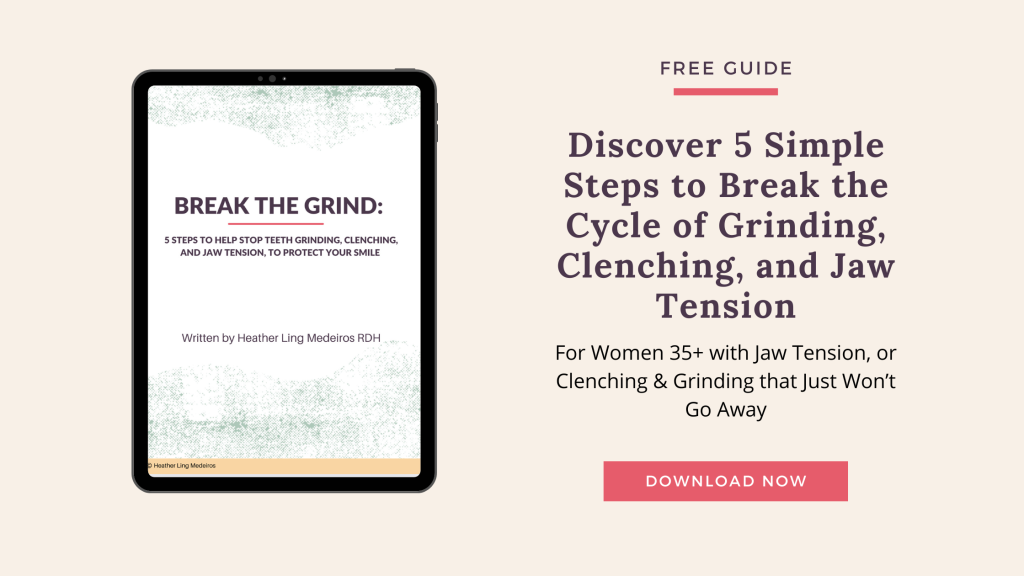
Break The Grind: 5 Steps to Stop Grinding, Clenching, and Jaw Tension
Inside, you’ll learn simple strategies that help you sleep better, reduce jaw tension, support saliva health, and ease your stress — without adding more work to your already full days.
You deserve to feel clear, calm, and more like yourself again.
And you deserve fewer surprises at your next dental visit.
Discover 5 Simple Steps to Break the Cycle of Grinding, Clenching, and Jaw Tension